
Approach & Methodology
The science that goes into a Fat Cat build, how an engagement runs from first conversation to handoff, and why we price the way we do.
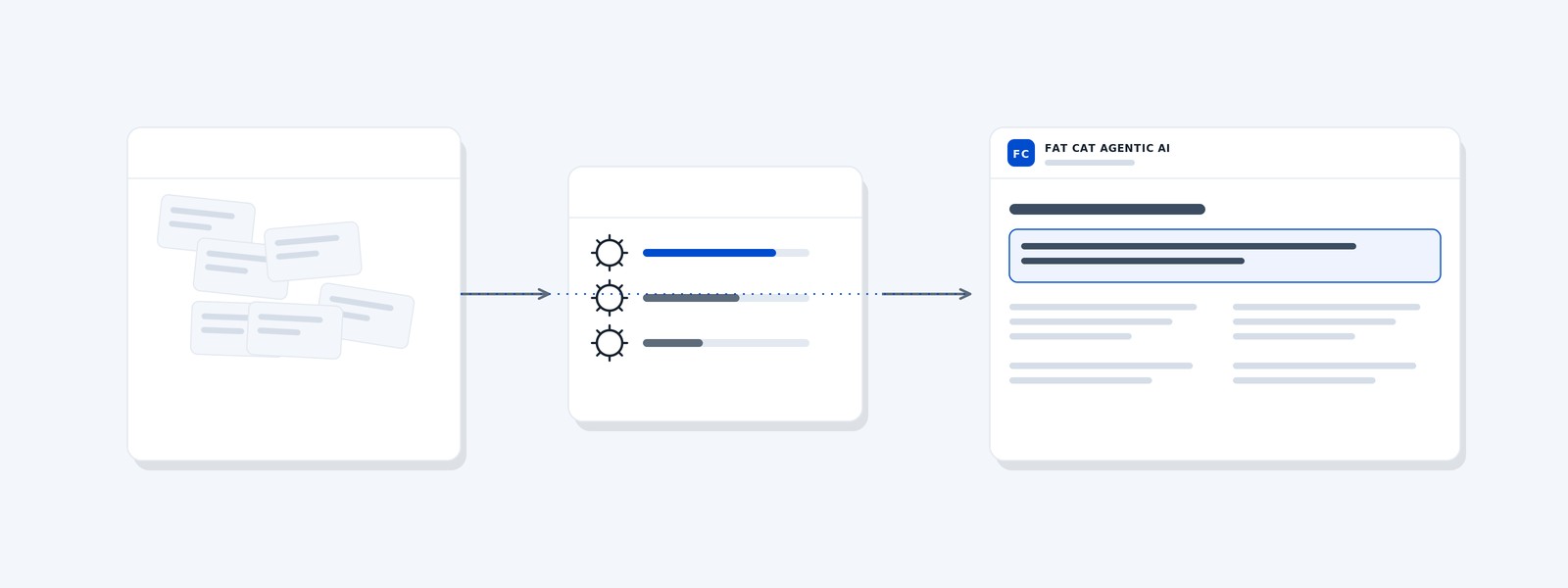
High-fidelity flat vector product mockup in enterprise SaaS marketing style, wide banner: a left-to-right pipeline of three application windows connected by thin arrows on a soft pale gray (#f3f6fa) field — left a window of scattered messy source cards, center a compact engine window with orderly geometric internals and small progress bars, right a clean briefing window with structured section blocks; the connecting flow line accented in royal blue (#004cce). White (#ffffff) panels with thin (#e3e9f1) hairline borders and very subtle drop shadows; charcoal (#16212e) primary marks; slate (#5d6b7b) secondary marks. All text as greeked placeholder bars — no legible words, letters, or numbers. Crisp straight-on geometry, generous spacing, modern and corporate, no people, no photographs Models first. AI second. In that order, always.
Most of what gets sold as "AI for sports" is a language model with a nice interface — fluent, confident, and unaccountable. We build in the opposite direction. At the core of every Fat Cat tool is a deterministic quantitative model: a ranking engine, a valuation function, an optimization routine, a statistical estimate with known assumptions. It is written down, versioned, and auditable. Run it twice on the same inputs and it gives the same answer. When a general manager asks "why is this player ranked eighth?", the answer is arithmetic, not vibes.
The disciplines are the ones we've practiced for three decades: statistical modeling (Bayesian hierarchical models, mixed-effects regression, survival and aging-curve analysis), mathematics and operations research (combinatorial optimization, routing, cost modeling), physics (ball-flight and biomechanical reasoning about tracking data), and modern machine learning (computer vision, speech recognition, natural language processing, embeddings). The method is chosen to fit the question — never the other way around.
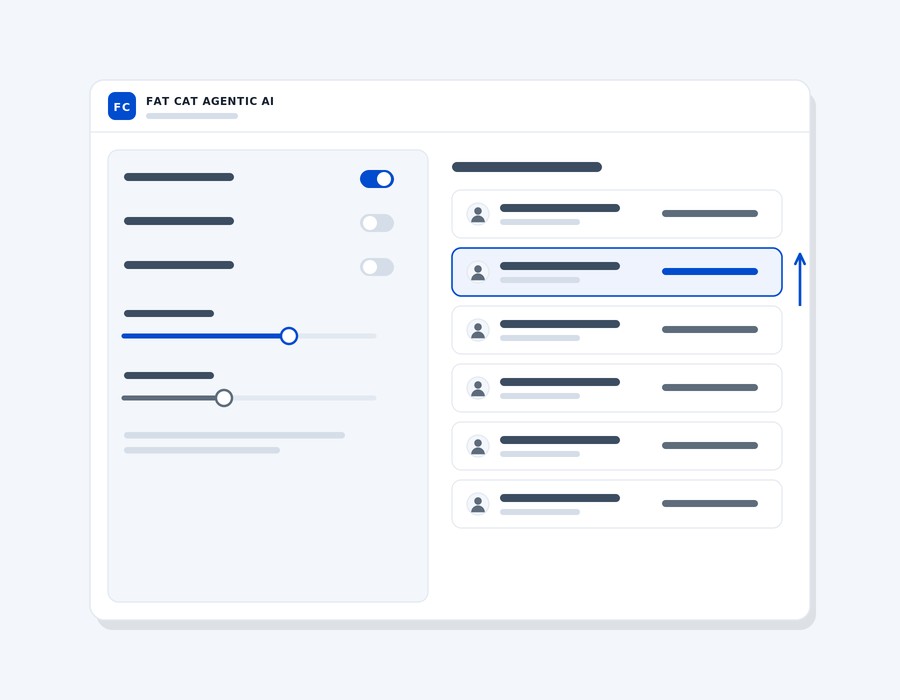
High-fidelity flat vector product mockup in enterprise SaaS marketing style: a model-configuration application window — a left column of labeled parameter rows with small toggle switches and two horizontal sliders, a right column showing an output ranking list with one row visibly re-ordered upward via a thin motion arrow, that moved row highlighted in royal blue (#004cce). Soft pale gray (#f3f6fa) page background; white (#ffffff) panels with thin (#e3e9f1) hairline borders and very subtle drop shadows; charcoal (#16212e) primary marks; slate (#5d6b7b) secondary marks; blue used only for the moved row and one active toggle. All text as greeked placeholder bars — no legible words, letters, or numbers. Crisp straight-on geometry, generous spacing, modern and corporate, no people, no photographs Where the AI comes in
On top of that deterministic core sits Fat Cat Agentic AI — the conversational layer our users know as "the Cat." It reads the model's output and the underlying evidence, explains what changed and why, drafts the scouting summary or the negotiation brief, and proposes next moves a user can accept with one click. Two rules govern every agentic system we ship:
- The model, not the AI, produces every number. The agent narrates, explains, and proposes — it is never the source of a ranking, a valuation, or a projection.
- Nothing exists without a source. Claims are linked to the document, article, data row, or note they came from. If the evidence isn't there, the tool says so instead of improvising.
This architecture is why our tools survive contact with skeptical baseball people. Staff can interrogate every claim, trace every number, and adjust every assumption — which is what turns a demo into a tool that gets opened every morning.
Built for the way front offices actually work
The systems we deliver are not notebooks or slide decks. They are login-gated web applications deployed privately for your organization: interactive boards with scenario controls, three-pane reading and chat workspaces, automated pipelines that refresh the data every night without anyone touching them, exports in the formats your organization already uses, and administrative dashboards so leadership can see what's being used.
Where the work is sensitive — personnel evaluations, internal grades — we build closed-loop: the AI is grounded exclusively in your curated material and reads nothing from the open web.
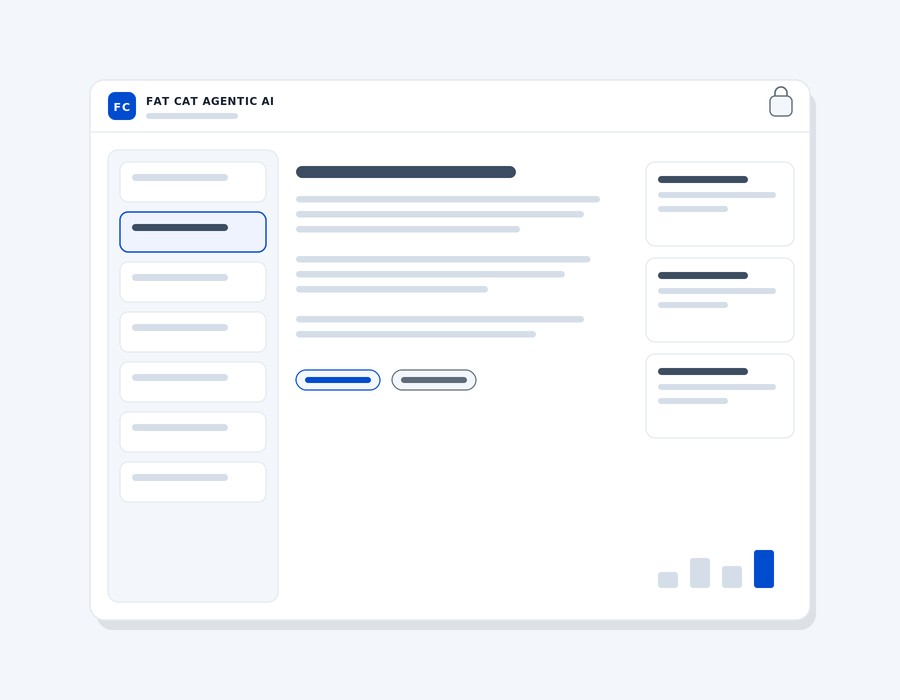
High-fidelity flat vector product mockup in enterprise SaaS marketing style: a secure workspace application window with a small padlock badge in its title bar — three panes: a narrow left list column, a central reading column of neat paragraph blocks, a right column of small cards, plus a tiny admin bar-chart widget in one corner; the active list row highlighted in royal blue (#004cce). Soft pale gray (#f3f6fa) page background; white (#ffffff) panels with thin (#e3e9f1) hairline borders and very subtle drop shadows; charcoal (#16212e) primary marks; slate (#5d6b7b) secondary marks. All text as greeked placeholder bars — no legible words, letters, or numbers. Crisp straight-on geometry, generous spacing, modern and corporate, no people, no photographs Five stages, one price, no surprises
We are consultants: you hire us to build. Here is what hiring us looks like in practice.
- 01 · Describe
-
It starts with a conversation, not a requirements document. You tell us what you wish existed — "I want to know what the public web thinks of our draft class," "our scouts burn too much budget on the road," "I need contract comps I can defend in a room." We ask questions until we understand the decision the tool has to improve.
- 02 · Scope
-
We come back with a written scope: what the proof of concept will do, what data it needs, what it deliberately leaves out, how long it takes, and what it costs. One number for the project. If the scope changes, the document changes — in the open, before the work.
- 03 · Proof of concept
-
A working system on real data, delivered fast enough to judge honestly. The PoC exists to answer one question: is this worth building properly? Sometimes the answer is no — and a fast, inexpensive "no" is one of the most valuable things a consultancy can sell you.
- 04 · MVP
-
When the PoC earns it, we harden it into a minimum viable product: private deployment, authentication, automated data refresh, exports, admin visibility, and the reliability your staff needs to trust it during the season. Same per-project pricing — scoped and agreed before we start.
- 05 · Handoff
-
Every engagement ends with a handoff pack — architecture documentation, deployment runbooks, decision logs, and training for the people who'll run it — plus two weeks of hosted, supported testing so your staff can work the tool on real questions before you take the keys. The code, the models, and the data pipelines are yours. And if you'd rather never think about servers at all, that's what comes next.
Take the keys — or have us keep it running
Every build ends with two weeks of hosted testing included. After that, some clients take the handoff pack and run the tool themselves. Most ask us to keep operating it. Operations plans are flat monthly agreements scoped to the tool — cancel anytime, and everything remains yours. It's a service, never a license.
Managed hosting & operations
Your tool run as a private, login-gated deployment — in your cloud accounts or ours — with uptime monitoring, TLS, automated backups, tested restores, and someone who notices before your scouts do.
Maintenance & support
Security patches, dependency updates, and bug fixes as a matter of course, plus a monthly allowance of small changes — a new filter, a new export, a tweak to a report. A named contact and defined response times, in writing.
Model & data operations
Quantitative tools decay without care. We watch the nightly pipelines, monitor for drift, recalibrate models on a set cadence, and handle the rollovers — new season, new draft class, new data source — so the numbers stay trustworthy.
DevOps engineering
The engineering spine under the tool: CI/CD pipelines, staging environments, infrastructure-as-code, logging and alerting, and incident response with a defined escalation path when something breaks at a bad hour.
Cloud cost management
AI systems have real running costs — collection, interpretation, compute. We meter them, set budgets and alerts, right-size what's oversized, and send a monthly report that says what the tool cost and why. No surprise invoices from your cloud provider.
Surge support & training
Standby coverage for the weeks that matter — draft week, trade deadline, signing periods — with rapid-response staffing while the room is live, plus onboarding and refresher training whenever your staff turns over.
Per project, on purpose
The analytics industry runs on recurring revenue: per-seat licenses, annual platform fees, contracts that renew whether or not anyone opens the tool. We priced Fat Cat Data the other way deliberately. Every engagement is priced per project and billed on a project basis. No subscriptions. No seat licenses. No per-user math when you add an intern in July.
We work this way for three reasons. First, it aligns incentives: we get paid to deliver a working tool, not to maximize the months you stay subscribed. Second, it keeps scope honest — a fixed price forces a sharp definition of done, which is exactly the discipline good software needs. Third, it respects how sports organizations actually budget: a defined project with a defined cost is something a front office can approve, point to, and evaluate.
And because you own the deliverable outright, the economics compound in your favor: the tool keeps working for you long after the invoice is paid, and no competitor can license it. The one recurring thing we offer is operations — a flat monthly service for running what you own. It's optional, it's cancel-anytime, and walking away costs you nothing but the labor of running it yourself: the tool, the code, and the data never stop being yours.
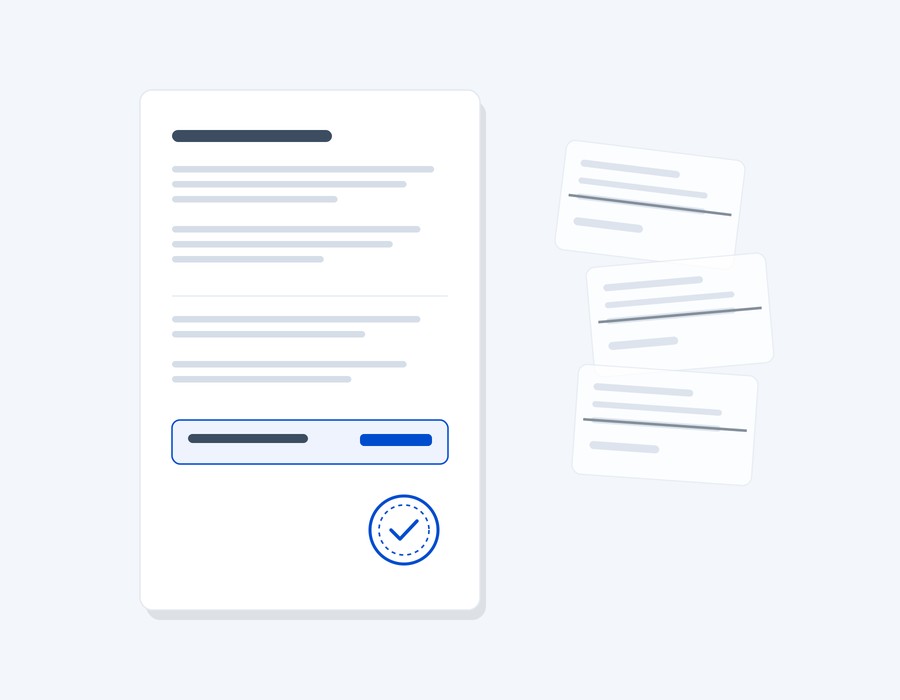
High-fidelity flat vector product mockup in enterprise SaaS marketing style: a scope-document card centered on a soft pale gray (#f3f6fa) field — one clean upright document panel with greeked section blocks, a single prominent highlighted total line, and a small round royal blue (#004cce) seal stamp; behind it, faded and clearly secondary, a small stack of repeating subscription invoices struck through with one thin slate (#5d6b7b) line. White (#ffffff) panels with thin (#e3e9f1) hairline borders and very subtle drop shadows; charcoal (#16212e) primary marks. All text as greeked placeholder bars — no legible words, letters, or numbers. Crisp straight-on geometry, generous spacing, modern and corporate, no people, no photographs Working with your data, carefully
Our tools routinely touch sensitive material — internal boards, medical and personnel context, scouting opinions. We deploy privately per client, gate every workspace behind authentication, keep sensitive systems closed-loop, log usage for your administrators, and never commingle one client's data, models, or insights with another's. Confidentiality terms are part of every scope document before work begins.
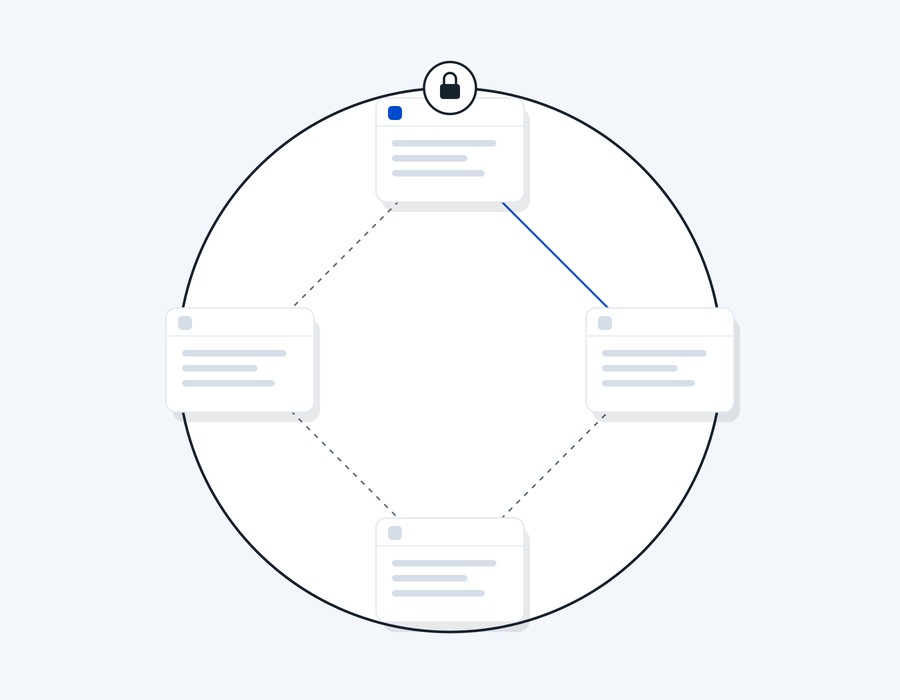
High-fidelity flat vector product mockup in enterprise SaaS marketing style: a closed-loop architecture diagram — four small application-window cards connected in a ring by thin charcoal (#16212e) lines, the entire ring enclosed by one continuous rounded boundary with a small padlock badge on its edge, nothing crossing the boundary, one connecting line accented in royal blue (#004cce). Soft pale gray (#f3f6fa) page background; white (#ffffff) window cards with thin (#e3e9f1) hairline borders and very subtle drop shadows; slate (#5d6b7b) secondary marks. All text as greeked placeholder bars — no legible words, letters, or numbers. Crisp straight-on geometry, generous spacing, modern and corporate, no people, no photographs