
Advance Scouting Game Day Intelligence
A nightly pipeline reads the public baseball web for every upcoming game and hands advance scouts an eight-section, source-cited brief — with a chat layer grounded in the evidence.
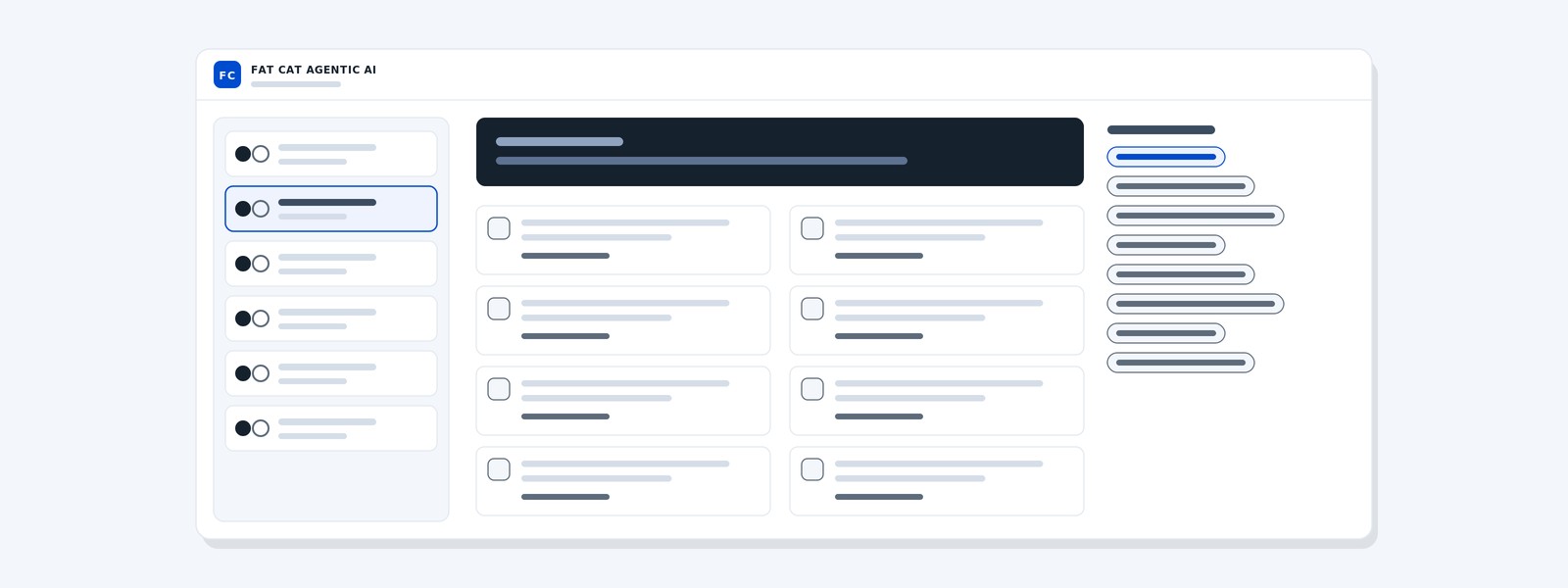
High-fidelity flat vector product mockup in enterprise SaaS marketing style: a three-pane intelligence-briefing application — a narrow left column listing upcoming games as rows with paired team dots, a wide central reading pane with a bold summary block and eight numbered section blocks of greeked text, a right rail of small citation chips, the active game row and one citation chip highlighted in royal blue (#004cce). Soft pale gray (#f3f6fa) page background; white (#ffffff) panels with thin (#e3e9f1) hairline borders and very subtle drop shadows; charcoal (#16212e) primary marks; slate (#5d6b7b) secondary marks. All text as greeked placeholder bars — no legible words, letters, or numbers. Crisp straight-on geometry, generous spacing, modern and corporate, no people, no photographs What it does
Every night, while the advance-scouting staff sleeps, this system reads the public baseball web for every game on the club’s schedule over the next week — beat reporting, injury news, roster moves, local coverage, statistical updates — cuts the noise, and writes a structured intelligence brief per game. Staff sign in the next morning, pick a game from the menu, and read.
Each brief is organized into eight advance-scouting sections: pitching and matchups; opponent hitters; health and roster; the running game and defense; bullpen and manager tendencies; local and insider reporting; context and edges (park, weather, travel, market signals); and form, stakes, and umpire. A bottom-line summary sits on top. And because the entire pipeline is built to be defensible, nothing in a brief exists without a source — every claim links to the article or data it came from. A chat layer lets staff interrogate the evidence directly: ask about the matchup, get an answer grounded in the cited material, never a guess.
Operationally, it runs itself. The pipeline refreshes on a schedule in the early morning, publishes a fresh database to cloud storage, and the web app picks it up without a redeploy. Usage analytics show leadership what’s being read.
Who it’s for
Directors of advance scouting and their staffs — the people who currently spend the first two hours of every day doing this digging by hand — plus major-league coaching staffs who want the same read without the labor.
The quantitative methods
Scheduled web-scale collection with source weighting and deduplication; evidence normalization into a structured store; agentic interpretation that organizes raw material into the eight-section frame under strict citation discipline; and retrieval-grounded chat over the assembled evidence. The heavy steps — collection and interpretation — are engineered to run unattended and economically; everything else is deterministic and free.
Example outcomes
Representative outcomes: series prep that starts from a finished brief instead of an empty browser; hours of staff time returned every single day of the season; small edges — a tired bullpen, a wind pattern, an umpire tendency — surfaced consistently instead of when someone happens to look; and a defensible paper trail behind every claim that reaches a coaching staff.
From sample to engagement
The demo build covers a full major-league schedule horizon out of the box. An engagement version tunes the eight sections to your advance philosophy, weights the source list toward the beats and outlets your staff trusts, and can fold in your internal data alongside the public evidence — same citation discipline, wider foundation.
Related sample builds
Prospect Board Prediction
An interactive what-if draft board: a deterministic model ranks prospects from internal, external, and ball-tracking evidence, and staff move the weights to see how the board reorders.
Learn more → Contracts & valuationPlayer Contract Modeling
An agentic contract advisor for front offices: plain-English questions, numbers-first answers on draft bonuses and pro deals, grounded in a normalized contract database with comps and evidence.
Learn more →