
Scout Audio Note Taking & AI Insight Analysis
An offline-first, voice-first field platform: scouts tap-record notes at the park; the system transcribes, extracts entities and sentiment, and makes every observation searchable through grounded, cited AI chat.
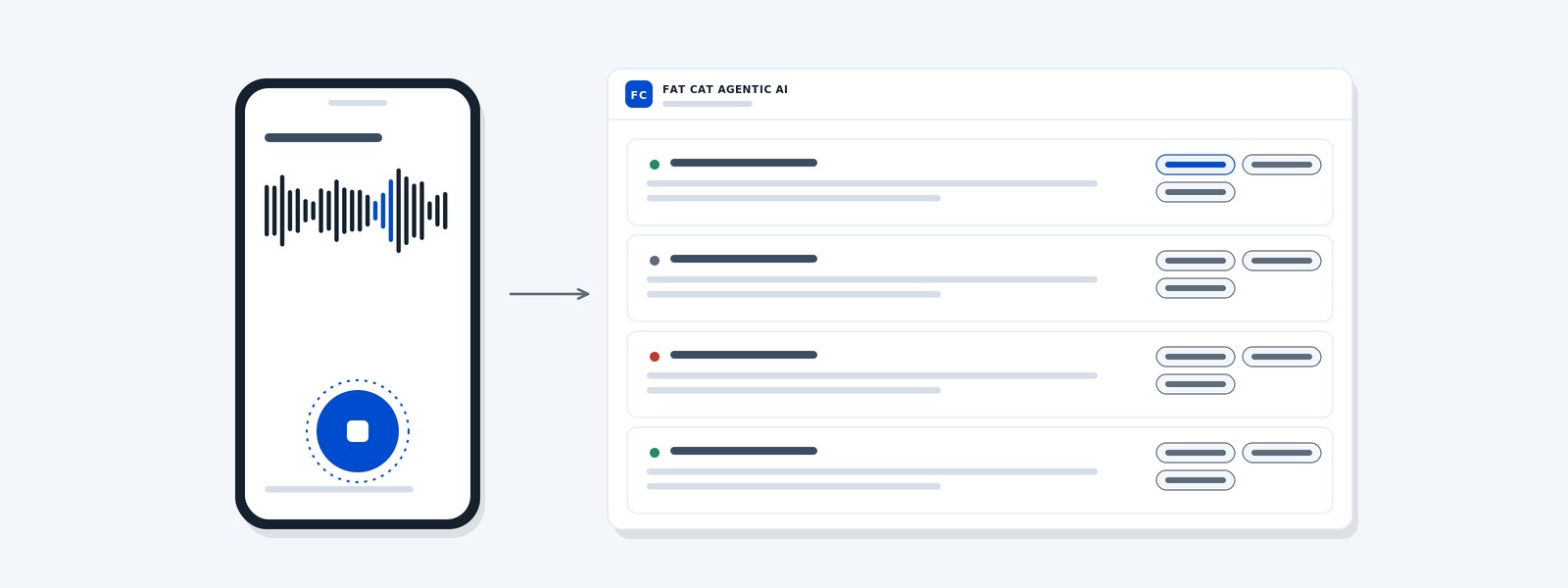
High-fidelity flat vector product mockup in enterprise SaaS marketing style: a voice-notes platform composition — a phone-shaped recorder card on the left with a large round record button and a live audio waveform, flowing rightward into a review-console window with transcript cards carrying small tag chips and sentiment dots, exactly one tag chip and the record button rendered in royal blue (#004cce). Soft pale gray (#f3f6fa) page background; white (#ffffff) panels with thin (#e3e9f1) hairline borders and very subtle drop shadows; charcoal (#16212e) primary marks; slate (#5d6b7b) secondary marks. All text as greeked placeholder bars — no legible words, letters, or numbers. Crisp straight-on geometry, generous spacing, modern and corporate, no people, no photographs What it does
The best scouting observations happen in the fifth inning, not at the laptop that night — and a lot of them die between the two. This build is a voice-first field platform that catches them at the moment they happen. A scout opens a lightweight app on their phone, taps once, and talks. That’s the entire field workflow.
Everything else is automatic. The app is offline-first — built for ballparks with bad signal — so recordings queue locally and sync to the cloud when a connection appears. Once synced, each note is transcribed, then enriched: player and team names extracted and resolved, sentiment scored, and the content embedded for semantic search. Directors get a review console with the full stream of field notes as they arrive. And the whole corpus becomes conversational: staff ask questions in plain language — what have we said about this shortstop’s arm over the past month? which of our guys sounded down on the outfielder after the showcase? — and Fat Cat Agentic AI answers grounded strictly in the notes, citing the specific recordings behind every claim.
The demo system runs end to end today: mobile capture, cloud pipeline, review console, and cited chat, deployed as a set of private, login-gated services.
Who it’s for
Scouting departments of any size — area scouts and crosscheckers who capture more when capture costs nothing; directors who currently sample a fraction of their field staff’s observations; and organizations that want scouting memory to be an asset that compounds instead of an inbox that scrolls away.
The quantitative methods
Automatic speech recognition tuned for short field notes in noisy environments; named-entity extraction with roster-aware resolution; sentiment scoring; text embeddings powering semantic search; retrieval-grounded chat with mandatory citation; and offline-first sync architecture on the capture side. The AI answers only from the corpus — if the notes don’t say it, the Cat doesn’t either.
Example outcomes
Representative outcomes: multiples more field observations captured per scout with zero added workload; directors reading the field’s sentiment on a prospect in minutes instead of a road trip’s worth of phone calls; instant, cited answers to “what do we actually know about this kid?”; and a searchable institutional memory that stays when a scout retires.
From sample to engagement
The PoC stage puts the recorder in a handful of scouts’ pockets for a few weeks of real games and lets the corpus speak for itself. The MVP stage hardens the pipeline for a full department — roster-aware entity resolution tuned to your coverage, retention and access policies set to your standards, and the review console fitted to how your directors actually work a draft cycle.