
Prospect Board Prediction Modeling
An interactive what-if draft board: a deterministic model ranks prospects from internal, external, and ball-tracking evidence, and staff move the weights to see how the board reorders.
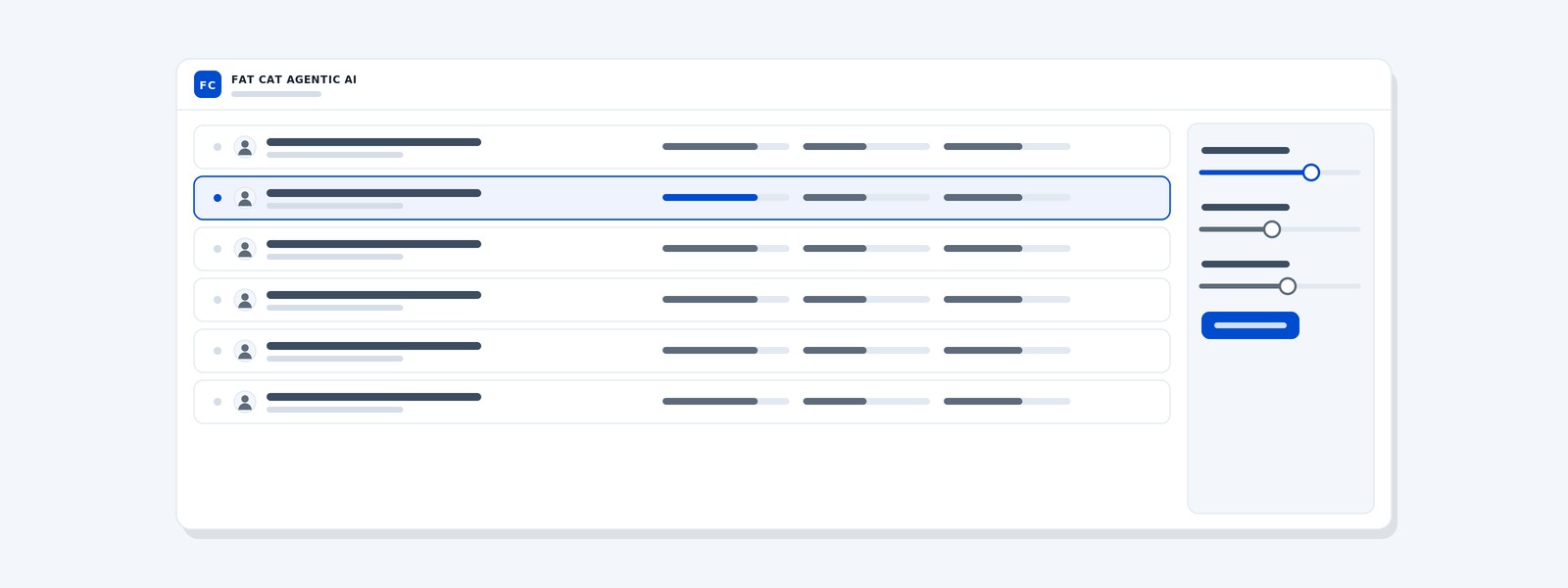
High-fidelity flat vector product mockup in enterprise SaaS marketing style: a wide draft-board web application window with a top navigation bar holding a small square logo chip and one tab underlined in blue, below it a ranked list of player rows as white cards with small circular avatars and horizontal stat bars, a right-hand panel with three weight sliders and small toggle chips, exactly one row highlighted in royal blue (#004cce). Soft pale gray (#f3f6fa) page background; white (#ffffff) panels with thin (#e3e9f1) hairline borders and very subtle drop shadows; charcoal (#16212e) primary marks; slate (#5d6b7b) secondary marks; blue reserved for the active tab, one button, and the highlighted row. All text as greeked placeholder bars — no legible words, letters, or numbers. Crisp straight-on geometry, generous spacing, modern and corporate, no people, no photographs What it does
This build turns a club’s amateur-draft board — a couple hundred names, in the version we can demo — into a live scenario tool. A deterministic model ranks every prospect from three pillars of evidence: the internal pillar (the club’s own board and grades), the external pillar (a structured read of what the public and industry sources are saying, gathered continuously from the web), and a performance pillar built from ball-tracking data. Each pillar is computed independently, normalized, and combined into a single board.
The interface is where it earns its keep. Weight sliders let staff shift how much each pillar matters and watch the board reorder in real time. Per-player “what-ifs” let a room test targeted questions — what if we trust our grade over the industry on this arm? what if the tracking data is right and everyone else is wrong? — without anyone touching a spreadsheet. An AI assistant sits alongside the board to explain any ranking in plain language, draft scouting summaries, and propose weight or what-if changes a user can apply with one click. The discipline is absolute: the model, not the AI, produces every number. The assistant narrates and proposes; it never invents a rank.
Who it’s for
Scouting directors, draft-room analysts, and the general manager’s staff in the weeks before and during a draft. It’s built for the room where the argument happens — when someone asks “why is he eighth?”, the answer traces to arithmetic and evidence, not to a black box.
The quantitative methods
The ranking engine is a deterministic multi-pillar scoring model over a single unified feature table — every input visible, every transformation versioned. The external pillar applies natural-language processing and source weighting to public draft coverage; the performance pillar applies physics-informed feature engineering to ball-tracking measurements. Scenario analysis is exact, not simulated: weight changes recompute the full board instantly. After draft day, a companion evaluation module scores the board against what actually happened — pick by pick — so the model’s calibration is measured, not assumed.
Example outcomes
Representative of what this class of build delivers: a draft room that can stress-test its board against the industry consensus in seconds rather than meetings; defensible answers when a ranking is challenged; written scouting summaries drafted in the club’s own voice from the evidence on file; and a post-draft report that shows exactly where the board beat the market and where it didn’t — the feedback loop most draft operations never close.
Ask us to demo it, or describe what your draft room would need instead — this build is the template, not the limit.