
Player Contract Modeling
An agentic contract advisor for front offices: plain-English questions, numbers-first answers on draft bonuses and pro deals, grounded in a normalized contract database with comps and evidence.
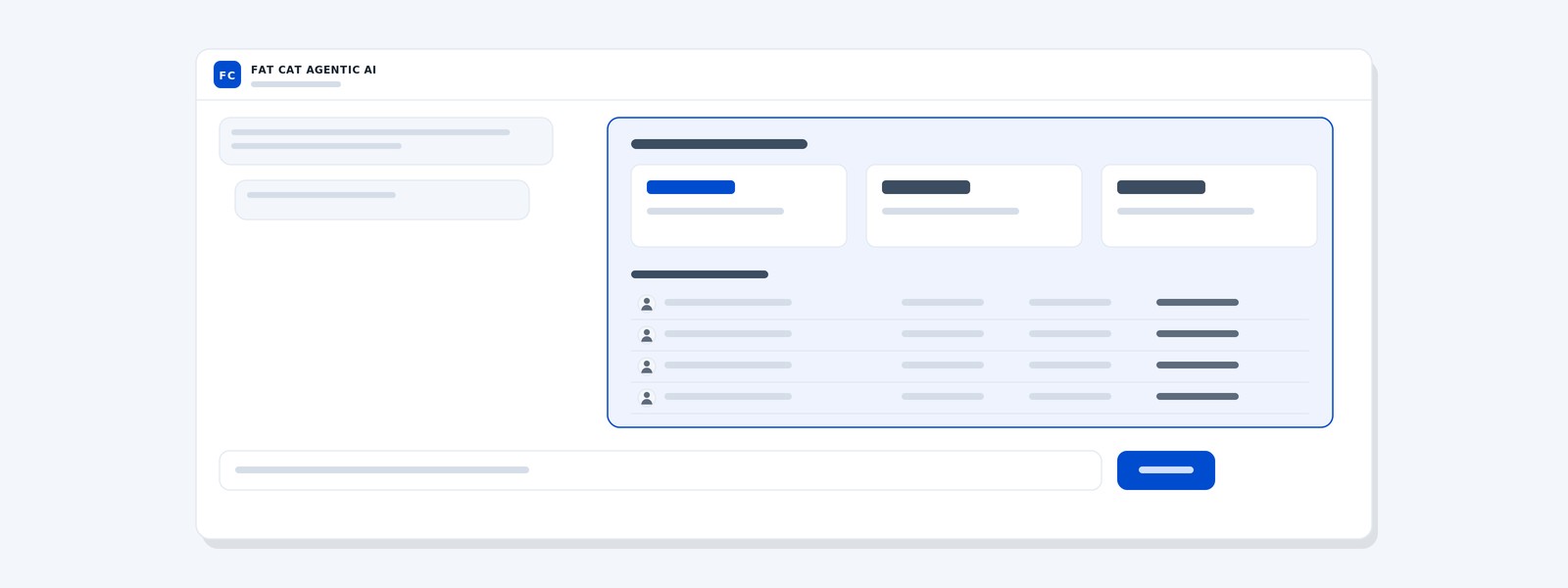
High-fidelity flat vector product mockup in enterprise SaaS marketing style: a contract-advisor chat application window — a conversation thread with alternating message bubbles, the assistant's reply shown as a numbers-first summary card holding three large stat blocks and a small comparison table of greeked rows, a text input bar with a royal blue (#004cce) send button at the bottom. Soft pale gray (#f3f6fa) page background; white (#ffffff) panels with thin (#e3e9f1) hairline borders and very subtle drop shadows; charcoal (#16212e) primary marks; slate (#5d6b7b) secondary marks; blue used only for the send button and one highlighted stat block. All text as greeked placeholder bars — no legible words, letters, or numbers. Crisp straight-on geometry, generous spacing, modern and corporate, no people, no photographs What it does
This build is an agentic contract advisor for a professional baseball front office. A general manager, assistant GM, or analyst types a plain-English question — what should we offer our second-round pick? what does a two-year extension for this reliever look like against the market? — and the system answers with numbers first: a recommendation, the comparable deals behind it, and the evidence trail for every figure.
It operates in two domains. For draft signings, it anchors bonus recommendations to slot value and the full history of comparable signings — pick position, demographic, class dynamics. For pro contracts, it values arbitration cases, extensions, and free-agent deals using market comps and production-based valuation. Underneath sits a normalized database built by a data pipeline that collects and reconciles publicly available contract, draft, and performance data into one queryable source of truth. The conversational layer — Fat Cat Agentic AI — orchestrates a comps-and-valuation engine over that database and, when the question calls for it, live web search for late-breaking market context. The engine produces the numbers; the agent assembles the argument.
Who it’s for
The people who have to put a figure on the table: GMs and AGMs preparing negotiations, directors running draft-signing budgets, and analysts who currently rebuild the same comps spreadsheet every time a name comes up.
The quantitative methods
Entity resolution and normalization across messy public contract data; comparable-deal retrieval with similarity scoring across production, age, position, and service time; dollars-per-win valuation curves fitted to market history; aging and survival analysis for multi-year projections; and slot-anchored bonus modeling for the draft domain. The valuation engine is deterministic and versioned — the same question gets the same answer, and when the answer changes, the data changed, not the mood of a model.
Example outcomes
Representative outcomes for this class of build: negotiation prep that starts from a defensible number instead of a blank page; draft-signing recommendations that keep a bonus pool coherent across twenty picks; extension analyses that surface the three deals the other side will cite before they cite them; and an institutional memory of contract logic that survives staff turnover.
From sample to engagement
The demo version runs entirely on public data — that’s what makes it demonstrable. An engagement version would run on yours: your internal valuations, your medical and makeup context, your payroll strategy, folded into the same numbers-first architecture. The PoC stage typically proves the comps engine against deals your office already knows cold; the MVP stage puts the advisor in the room for a live negotiation cycle.
Related sample builds
Prospect Board Prediction
An interactive what-if draft board: a deterministic model ranks prospects from internal, external, and ball-tracking evidence, and staff move the weights to see how the board reorders.
Learn more → Front officeEmployee Evaluation Analysis
An AI-guided 360 evaluation workspace for baseball-operations staff: rough notes go in, a fair, evidence-based, rubric-grounded evaluation comes out — reviewed by you, exported as PDF or DOCX.
Learn more →