
Web Draft Intelligence
An evidence-linked read on how the public web values a draft class: consensus, red flags, and disagreements for ~150 prospects, every claim cited — a calibration layer beside internal grades.
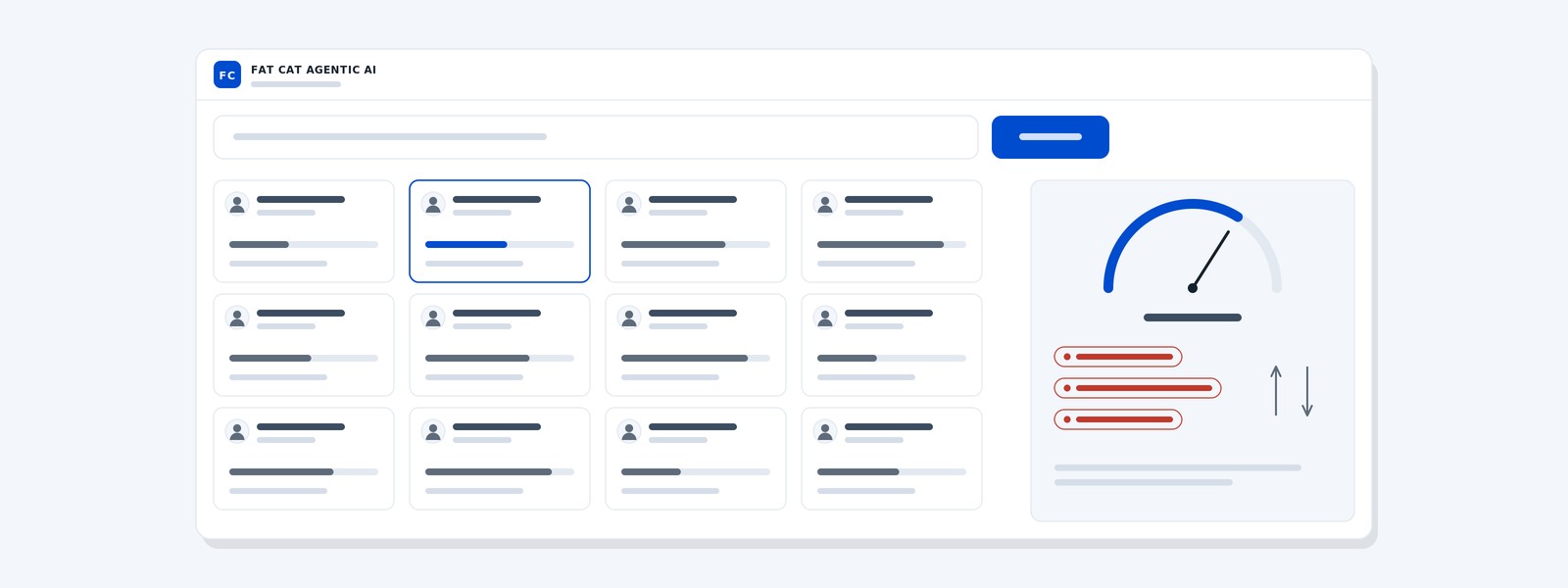
High-fidelity flat vector product mockup in enterprise SaaS marketing style: a draft-class research application window — an ask-anything search bar with a royal blue (#004cce) button at top, below it a grid of small prospect cards each with an avatar circle and a consensus meter bar, a right detail panel showing a semicircular consensus gauge, a column of small red-flag chips, and a disagreement indicator. Soft pale gray (#f3f6fa) page background; white (#ffffff) panels with thin (#e3e9f1) hairline borders and very subtle drop shadows; charcoal (#16212e) primary marks; slate (#5d6b7b) secondary marks; blue used only for the button, one card border, and the gauge needle. All text as greeked placeholder bars — no legible words, letters, or numbers. Crisp straight-on geometry, generous spacing, modern and corporate, no people, no photographs What it does
Before a draft, the public web contains an enormous, disorganized second opinion on every prospect a club is considering — rankings, mock drafts, beat reporting, showcase write-ups, injury chatter. This build turns that sprawl into a fast, structured, evidence-linked external-opinion read on roughly 150 draft prospects.
A scout signs in, opens a prospect, and gets the industry’s view in minutes: where the consensus sits, where sources disagree with each other, what red flags keep recurring, and — just as important — what the public record is missing. A chat layer answers questions grounded strictly in the collected evidence, and a draft-board view lets staff browse the class the way they already think about it. Every claim is cited to its source; the tool is deliberately built as a calibration layer that sits beside a club’s internal grades, never a replacement for them. When your board and the industry diverge on a name, that divergence is exactly the information you want walking into a draft room.
The system maintains itself through draft season: a scheduled nightly job re-collects the web evidence, re-interprets it, rebuilds the database, runs quality checks, and publishes the result to cloud storage — the live app updates without a redeploy or a human in the loop.
Who it’s for
Amateur scouting departments in the run-up to a draft: scouting directors, crosscheckers who want the industry read on a name before a look, and analysts responsible for knowing where the club’s board differs from the market — and why.
The quantitative methods
Web-scale evidence collection with source weighting; entity resolution across inconsistent prospect naming; natural-language interpretation of qualitative coverage into structured fields; consensus and disagreement modeling across sources; recurring red-flag detection; and an automated QA pass that gates every nightly rebuild. Strict citation discipline throughout — an uncited claim doesn’t ship.
Example outcomes
Representative outcomes: a quantified market read on the full class before day one; divergence flags that focus crosschecking trips on the names where the club’s opinion is genuinely contrarian; early signal on availability — who the industry is cooling on and who is rising; and a written, cited record of the external view that a draft room can cite in the moment instead of half-remembering.
From sample to engagement
The demo tracks a real draft class end to end. An engagement version connects the external read to your internal board so divergence is computed, not eyeballed — and the same collection-and-interpretation machinery extends naturally to other domains: transfer portals, international classes, or any market where the public record holds opinion your organization should be pricing.